|
|
|
|
Weekly Insights for Entrepreneurs
|
|
|
|
|
| Year: 2026-27 |
Tuesday 3rd March, 2026 |
Volume/Issue: 117 |
|
|
|
|
- EU Compliance Support: Govt to fund major EU compliance costs for SME exporters (CBAM/REACH)
|
- Better Local Insights: Using granular MSME data to map hyperlocal economic activity
|
- Food Compliance Update: FSSAI likely to mandate daily operational records for food MSMEs
|
- New Digital Gateway: MSME Ministry launches Udyami Bharat portal + Technology Transfer Platform
|
- Credit Behaviour Shift: How repeat borrowing is reshaping MSME financing patterns
|
- Semicon Mission 2.0: Focus on design ecosystem and deep-tech startups
|
- Railways Innovation Route: New Rail Tech policy unveiled to tap startups
|
- Scale Reliability: Infrastructure readiness as the hidden driver of startup scalability
|
|
| |
|
|
- Energy & Trade: India–Canada seal $2.6B uranium deal; partnership framework and trade target
|
- GDP Framework Revamp: India’s revised GDP estimates and new measurement base (2022–23)
|
- Reform Collaboration: PM Modi moots ‘reform partnership charter’ with industry and lenders
|
- Credit Cycle Strengthening: Commercial credit up ~15% as rate cuts spur demand
|
- Carbon Markets: India set to launch its first comprehensive carbon-trading programme
|
- Textiles Push: Fiscal incentives on cards to boost India’s share in fibre production
|
- Digital Commerce Growth: India’s e-commerce market may double to $180–200B by 2030 (MSMEs/D2C)
|
- Standards & Compliance: Govt amends BIS rules to quicken certification, tighten norms
|
|
| |
|
|
- Cooling Efficiency: IIT Delhi retrofit module to cut AC power use (1200W to ~800W)
|
- Anti-Resistance Therapy: IIT Gandhinagar’s ultrasound-activated molecules to kill drug-resistant bacteria
|
- Defence Milestone: DRDO completes successful VSHORADS flight trials
|
- Energy Storage: Indian zinc battery retains ~98% capacity after 500 cycles
|
- Low-Cost Chip Making: IISER Bhopal tech to support cheaper microfabrication/masks
|
- Space Startup Progress: Agnikul test-fires clustered semi-cryogenic rocket engines
|
|
| |
|
|
|
|
|
|
The government has announced support to help micro and small exporters meet costly European Union compliance requirements, as non-tariff rules tighten alongside tariff negotiations.Commerce and Industry Minister Piyush Goyal said a large part of expenses for international approvals—covering regimes such as the EU’s Carbon Border Adjustment Mechanism (CBAM) and chemical compliance under REACH—will be funded through the Export Promotion Mission.
For MSME exporters, the takeaway is to treat compliance as a market-entry investment rather than a one-off paperwork exercise. Firms should map product-level EU requirements early, budget for testing and certification, and apply for reimbursement support to protect margins while scaling exports.
|
|
|
|
|
|
|
|
|
A new research note argues that granular MSME datasets can reveal hyperlocal economic activity far better than broad proxies like night-light intensity, helping policymakers and lenders see where growth is actually happening.
Using enterprise-registration data, the authors illustrate how activity can be mapped at very fine geographic levels, such as pin codes, to identify clusters, supply-chain links and gaps that aggregate GDP numbers hide.
For MSME leaders, this shift matters because it strengthens the case for targeted infrastructure, skilling and credit programs in specific industrial pockets. Businesses should ensure their registrations and updates are accurate, as better data can translate into more precise support, faster ecosystem development and improved visibility to financiers and buyers.
|
|
|
|
|
|
|
|
|
India’s food safety regulator FSSAI is moving to mandate daily operational records for food businesses, aiming to improve traceability and strengthen monitoring of production and storage practices.
The requirement is expected to raise compliance workloads, especially for smaller manufacturers, who may need to document inputs, batch details, cleaning schedules and storage conditions more systematically than before.
For food MSMEs, the key is to treat record-keeping as a risk-control tool, not just a regulatory chore. Set up simple digital logs, assign responsibility on the shop floor, and standardize batch coding so recalls and audits are manageable. Early adoption can reduce disruption, limit penalties, and improve credibility with modern trade, exports and institutional buyers.
|
|
|
|
|
|
|
|
|
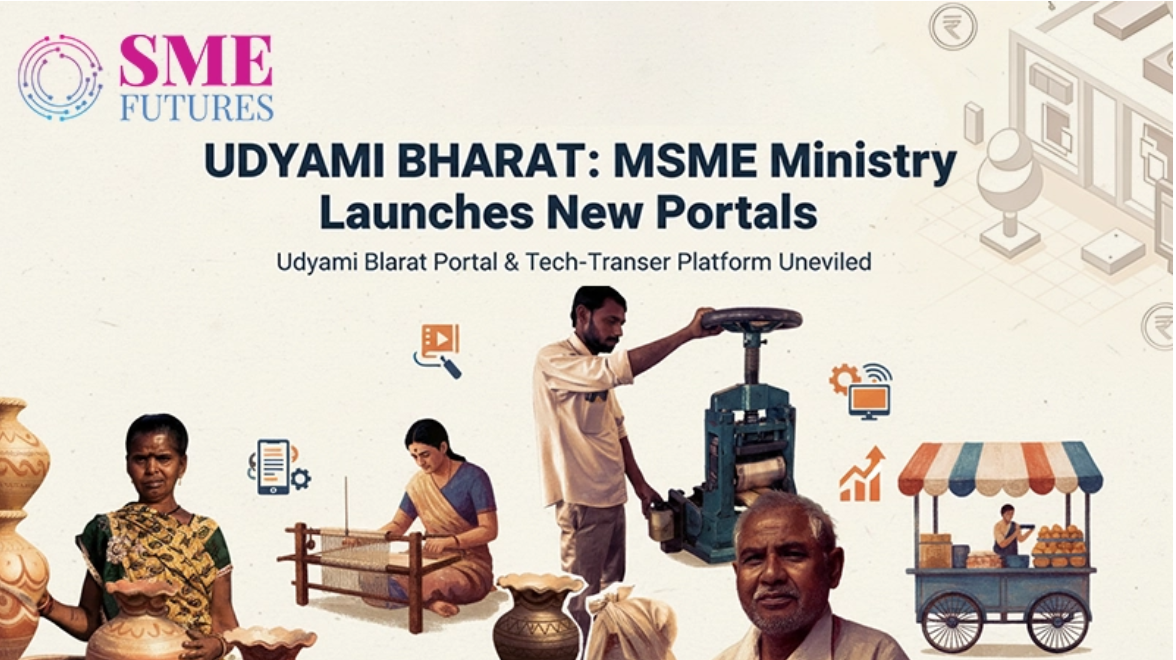
The MSME Ministry has launched the Udyami Bharat Portal as a ‘one-stop’ digital gateway that integrates existing ministry portals and links services from other central ministries and state governments.
Unveiled at the 5th National MSME Council meeting reviewing the World Bank-supported RAMP programme, the platform is positioned to streamline access to schemes, information and service delivery across multiple agencies.
Alongside it, the MSME Technology Transfer Platform is meant to help firms discover and adopt advanced technologies by connecting them to testing facilities, skilling, and IP-commercialisation support. For MSMEs, the immediate payoff is faster discovery of relevant schemes and partners; the longer-term benefit is a clearer path to upgrading processes, products and competitiveness.
|
|
|
|
|
|
|
|
|
MSME borrowing behaviour is shifting from one-time term loans to repeat, short-cycle borrowing—often via revolving credit lines—to manage working capital volatility and faster inventory turns.
The trend reflects both demand and supply: enterprises are returning to familiar lenders for quicker top-ups, while financiers use repayment histories and cash-flow signals to price risk and automate renewals.
For business owners, this can lower friction but also raise the cost of complacency. Track utilisation, interest and fees across cycles, and avoid rolling short-term lines into long-term needs. Maintain clean GST, bank and invoice data to improve renewal terms, and diversify funding sources so a single lender’s limits don’t choke growth during peak seasons.
|
|
|
|
|
|
|
|
|
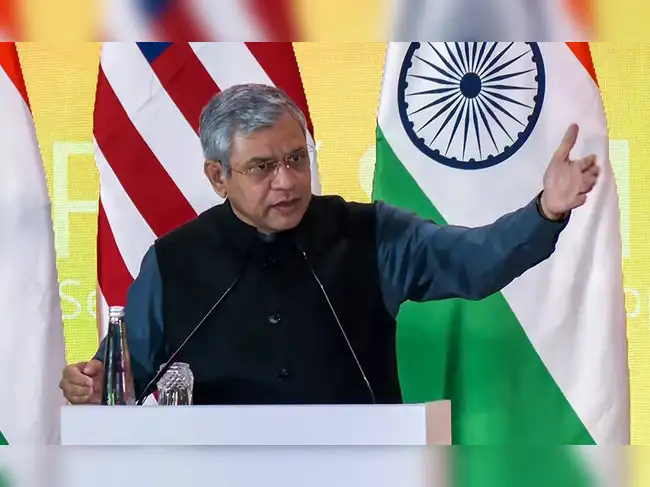
The Centre’s Semicon Mission 2.0 will pivot toward building a strong semiconductor design ecosystem and backing deep-tech startups, Union Minister Ashwini Vaishnaw said at Gujarat Semiconnect Conference 2026.
He indicated the second phase will differ from Semicon 1.0, which prioritised attracting manufacturing fabs, and will now focus on enabling design-led companies and developing domestic capabilities across equipment, testing and validation.
For startups, the opportunity is to build IP-rich chip and system designs that can plug into India’s emerging fabrication base and global supply chains. Entrepreneurs should align with university talent pipelines, tap prototyping and validation partners early, and plan for longer R&D cycles with patient capital and clear commercialization pathways.
|
|
|
|
|
|
|
|
|
Indian Railways has unveiled a new Rail Tech policy to engage startups, innovators, industry and institutions in solving operational and safety challenges across the network.
The policy is designed to keep the innovation window “permanently open”, simplify selection, and increase financial support for prototype development, trials and scale-up. Priority problem statements include AI-based detection systems and technology for monitoring rails, loads and coach safety.
For startups, this is a clearer route to pilot at national scale, with defined challenges and a faster path from lab to field trials. Companies should build solutions that can integrate with railway systems, demonstrate reliability in harsh conditions, and price for large deployments—while keeping an export roadmap in view once proven in India.
|
|
|
|
|
|
|
|
|
A Nasscom community note argues that infrastructure readiness—covering cloud capacity, cybersecurity, observability, data pipelines and scalable processes—is a hidden but decisive factor in whether startups can scale reliably.
It highlights a common pattern: teams race to product-market fit, then hit bottlenecks in performance, uptime, compliance and cost control when user loads spike or enterprise customers demand stricter SLAs.
For founders, the message is to treat infrastructure as a growth enabler, not a back-office expense. Build scalable architectures early, automate deployment and monitoring, and standardize security and compliance controls before large rollouts. Doing this reduces outages and rework, speeds onboarding of big clients, and makes unit economics more predictable as volumes expand.
|
|
|
|
|
|
|
|
|
India and Canada signed a $2.6 billion long-term uranium supply agreement to support India’s civil nuclear power programme, alongside a broader package of cooperation pacts. Leaders said the deal also opens collaboration on small modular and advanced reactors, linking energy security with low-carbon industrial growth.
The countries agreed to fast-track a Comprehensive Economic Partnership Agreement and set a goal of lifting bilateral trade to $50 billion by 2030. A parallel critical minerals pact aims to build more resilient supply chains for clean-tech and manufacturing inputs.
For the wider economy, the message is deeper resource-and-technology integration: stable fuel and minerals flows can de-risk investment, while a time-bound trade framework could expand market access and cross-border capital.
|
|
|
|
|
|
|
|
|
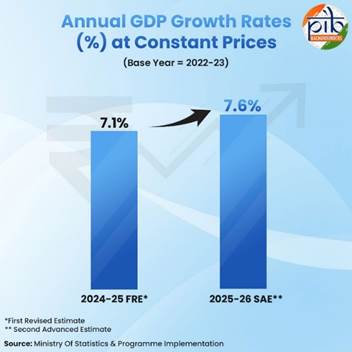
India has updated its GDP measurement by shifting the base year to 2022–23 from 2011–12 and integrating newer datasets such as GST, ASUSE, PLFS and PFMS, aiming to better reflect structural changes and improve estimation quality.
Under the revised series, real GDP growth for FY26 is estimated at 7.6% versus 7.1% in FY25, while nominal GDP growth is projected at 8.6%. The release highlights double-digit manufacturing growth in FY24 and FY26 and stronger secondary and tertiary sector momentum.
For the economy, the overhaul affects fiscal planning, debt ratios and investment decisions that rely on measured output. Richer, more timely data can sharpen policy design, but analysts will need careful splicing to preserve comparability across old and new time series.
|
|
|
|
|
|
|
|
|
Prime Minister Narendra Modi has proposed a “reform partnership charter” to formalise collaboration among government, industry, financial institutions and academia, urging private investment and innovation alongside rising public capital expenditure.
He said the government is simplifying the foreign investment framework to improve predictability, while calling for deeper liquidity, new risk-management instruments and sustained foreign capital. He also stressed better project appraisal, life-cycle costing and cost-benefit analysis to curb delays and waste.
The economic takeaway is a push to crowd in private capex and deepen markets—especially bond markets—to fund long-term growth. If paired with faster execution and stable rules, the agenda could lift productivity and competitiveness as India pursues major trade deals and its 2047 development goals.
|
|
|
|
|
|
|
|
|
Commercial sector credit rose 14.7% year-on-year to above ₹300 lakh crore by end-January, signalling stronger corporate borrowing after 125 basis points of RBI rate cuts intended to support growth.
Incremental credit in the first 10 months of FY26 reached ₹34.5 lakh crore, up 35% from a year earlier. Economists attributed the rise to lower rates plus substantial liquidity infusion, with banks regaining share versus non-bank channels.
The widening gap between bank and non-bank funding suggests improving transmission into bank lending, even as NBFC outstanding credit grew faster. For the economy, firmer credit can finance capex and working capital, but it also warrants close monitoring of leverage and asset quality as the cycle turns.
|
|
|
|
|
|
|
|
|
India is moving to operationalise its Carbon Credit Trading Scheme, with the Bureau of Energy Efficiency issuing emission-intensity targets for about 490 units across seven sectors. A portal to register projects and participate is slated for March 20, with operations expected from April.
The framework has two tracks: a mandatory compliance market and a voluntary offset market, with separate credit issuance and trading. Targets run for three years, while the government has published nine methodologies to validate offset projects and is developing more.
Economically, a carbon market can price emissions and lower abatement costs by enabling trade. However, the first phase excludes the power sector and still lacks announced targets for steel and fertilisers, limiting near-term coverage and price discovery.
|
|
|
|
|
|
|
|
|
The government is preparing fiscal measures under a National Fibre Scheme to lift India’s share in global fibre production and cut import dependence. Officials say it may rationalise import duties to level the field between natural and synthetic fibres and encourage domestic sourcing.
The textiles ministry is shaping a fibre-neutral roadmap that could include production-linked incentives, capital subsidies and support for modernisation and sustainability. Fibre labelling rules are also being weighed to improve transparency and traceability.
Economy-wide, stronger fibre capacity supports manufacturing scale-up, exports and jobs in a labour-intensive sector. India aims to raise fibre output by 2030-31 and increase its global share. The payoff will depend on whether incentives improve efficiency without pushing up costs for downstream apparel makers.
|
|
|
|
|
|
|
|
|
McKinsey projects India’s e-commerce market could almost double to $180–200 billion by 2030 from about $70–80 billion in 2024, with MSMEs and direct-to-consumer (D2C) channels driving much of the incremental growth.
A survey of 1,000+ MSMEs found 53% now prefer selling directly via their own websites or social platforms, versus 47% relying primarily on marketplaces. Tier-2 and Tier-3 cities already account for over 60% of shipments, helped by wider internet access, rising incomes and digital payments.
The macro implication is broader digital participation beyond metros, supporting formalisation, logistics investment and productivity gains. The shift also pressures marketplace fee models and increases demand for affordable fulfilment, payments and data tools tailored to small sellers.
|
|
|
|
|
|
|
|
|
India has amended the BIS (Conformity Assessment) Regulations, 2018 to speed up certification for select notified products by introducing a Self-Declaration of Conformity route. The change phases out mandatory pre-licence factory inspections under the revised Scheme-II, relying more on documentation checks and accredited lab test reports.
The framework shifts regulatory weight toward third-party testing and post-market surveillance, while codifying fees for applications and annual licences. At the same time, compliance is tightened: upfront annual payments and production returns become mandatory, with automatic suspension and eventual cancellation for lapses.
Economically, the reform aims to reduce approval bottlenecks for manufacturers—especially in electronics and IT—without diluting standards, supporting faster capacity expansion and improved export readiness.
|
|
|
|
|
|
|
|
|
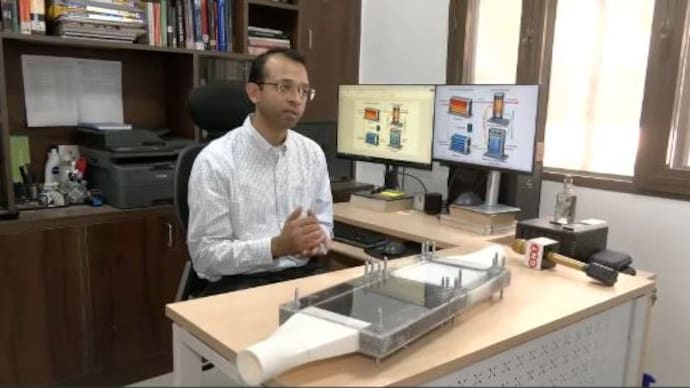
IIT Delhi has developed a compact add-on module for conventional room air conditioners that can cut operating power from about 1200 W to roughly 800 W, reducing electricity use by nearly one-third without changing comfort.
Standard vapour-compression ACs dehumidify by overcooling air so moisture condenses on coils, which raises compressor load. The hybrid design separates humidity control using a membrane–liquid desiccant stage: water vapour diffuses through a selective polymer membrane and is absorbed by a salt solution, while the membrane blocks salt carryover. The diluted desiccant is regenerated using waste heat from the outdoor condenser, avoiding a dedicated heater.
Performance modelling indicates 28–41.5% savings across Indian climates, making the retrofit a tool to lower peak summer demand and cooling-related emissions.
|
|
|
|
|
|
|
|
|
IIT Gandhinagar researchers have demonstrated ultrasound-activated molecules that could offer a non-antibiotic way to kill drug-resistant bacteria, targeting infections where conventional antibiotics are losing effectiveness.
The team used sonodynamic therapy, pairing ultrasound with a sonosensitiser molecule reported as an estrone-linked BODIPY. Under ultrasound—often enhanced with microbubbles—the sensitiser generates reactive oxygen species that damage multiple bacterial components, making resistance harder to evolve than with single-target drugs. Because ultrasound can penetrate centimetres into tissue, the approach is suited to localized deep-seated or implant-associated infections. Lab experiments reported bacterial killing rates up to 99.9%.
The work, published in Chemistry – An Asian Journal, is positioned as an early-stage platform for future translational studies and device-assisted antimicrobial therapies.
|
|
|
|
|
|
|
|
|
DRDO has completed three successive flight trials of its Very Short-Range Air Defence System (VSHORADS), demonstrating an indigenous, man-portable missile capability intended to counter fast, low-flying aerial threats.
During the tests from Chandipur off the Odisha coast, field operators acquired targets and fired missiles in their final deployment configuration. The system intercepted and destroyed high-speed aerial targets that mimicked enemy aircraft across different engagement scenarios, with performance validated by telemetry, electro-optical tracking, and radar instrumentation from the Integrated Test Range.
The defence ministry said the trials revalidated capability for varying speed, range, and altitude envelopes, and officials indicated the weapon could be inducted into the armed forces soon, strengthening short-range air defence coverage with domestic supply chains.
|
|
|
|
|
|
|
|
|
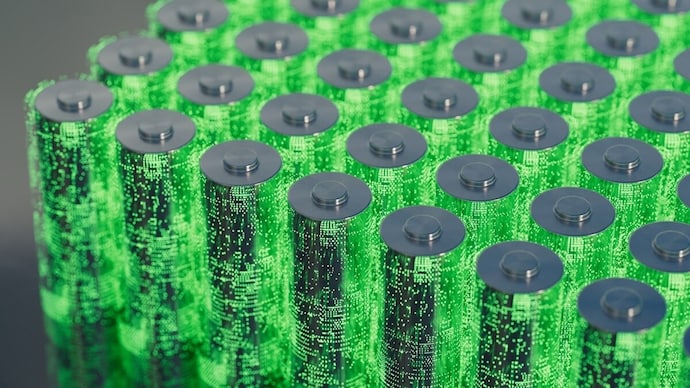
Researchers at the Centre for Nano and Soft Matter Sciences (CeNS) have demonstrated an aqueous zinc-ion battery material that keeps 97.91% of its capacity after 500 charge–discharge cycles, highlighting zinc chemistry as a safer, cheaper storage route.
To address the cathode bottleneck, the group engineered molybdenum disulfide with reduced sulfur and ultra-thin flakes, made via a controlled heating process to ease charge transport. Operating the cell in a stable 0.2–1.3 V window delivered 99.7% Coulombic efficiency, and a coin-cell prototype powered a commercial LCD timer.
Reported in ACS Energy & Fuels, the advance supports large, non-flammable storage for balancing solar and wind on grids, with next steps focused on scaling the architecture beyond lab-scale cells.
|
|
|
|
|
|
|
|
|
IISER Bhopal researchers report a low-cost microfabrication approach that could reduce the expense and infrastructure barriers associated with making photomasks and hard masks used in modern semiconductor manufacturing.
The method uses a thin chromium film and a sharp metal probe to trigger a controlled electrochemical reaction on the surface, “writing” nanometre- to micron-scale patterns directly—similar to drawing with a pen. Because it avoids photoresists, high-energy UV laser or electron-beam tools, ultra-clean facilities, and many hazardous chemicals, it can support both lithography and etching steps with lower energy input.
The team says it has filed two patents, positioning the technique as a pathway for wider academic and domestic prototyping that can complement India’s push for indigenous chip R&D and fabrication.
|
|
|
|
|
|
|
|
|
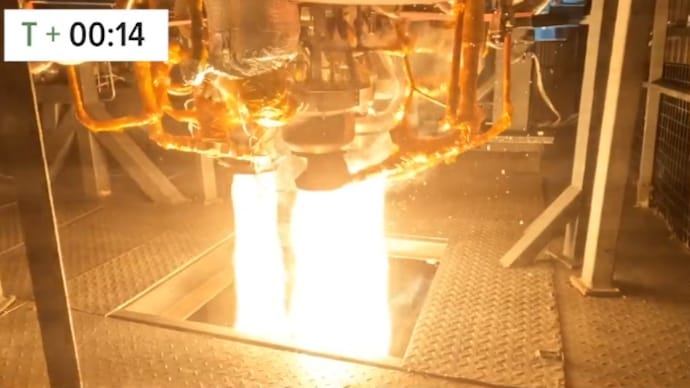
Chennai-based Agnikul Cosmos has successfully test-fired three semi-cryogenic rocket engines simultaneously, marking a key milestone in validating clustered propulsion needed to scale thrust for heavier payloads.
The 3D-printed engines, produced as single-piece hardware at the company’s Rocket Factory-1, ran on liquid oxygen and kerosene. The cluster firing relied on synchronized control of propellant feed using electric motors and pumps, with onboard software coordinating startup, steady-state operation, and shutdown. The company said the demonstration was supported by ISRO and IN-SPACe, and released a 62-second video of the run.
By proving multi-engine integration beyond single-engine stand tests, Agnikul strengthens its readiness for its Agnibaan launch vehicle, signalling faster, lower-cost private launch development in India.
|
|
|
|
|
 |
|
|
|
|
|
|
|
|
|
|
- Kindly add the email address masscomm@lubindia.com to your contact list or whitelist it for the newsletter.
|
|
|
|
|
|
|
|
|
|
|
|

)





)

)